SARGEX project launches to transform sargassum risk into sustainable solutions for Europe and beyond.

Updated: May 20
PRESS RELEASE
Barcelona, Spain
January 2026
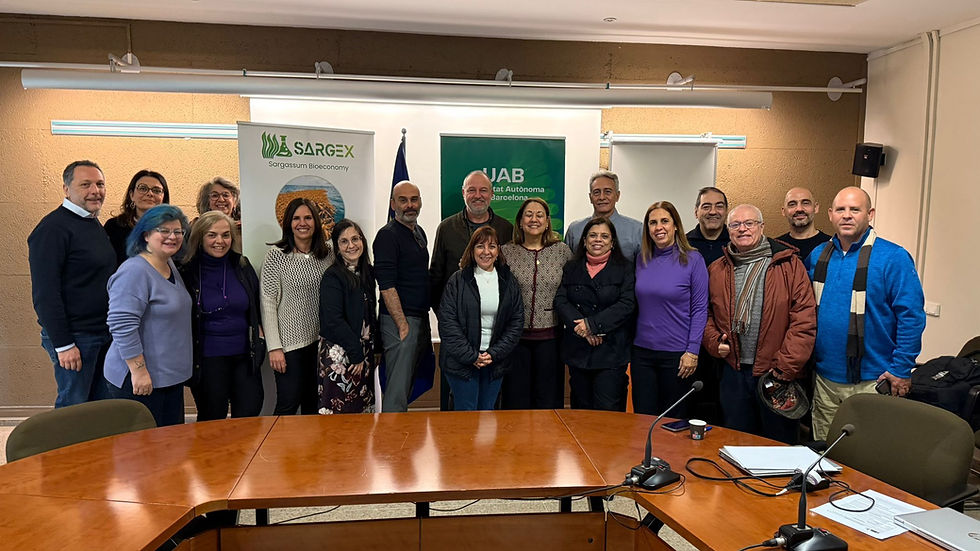
While Caribbean coastlines are already choking on sargassum, climate change is bringing this risk to Europe (Mediterranean/Baltic), which is now facing a fast-growing threat. A new EU initiative, SARGEX, launches today to stop this. SARGEX (Sargassum Bioeconomy: From Coastal Biomass to Advanced Sustainable Materials), officially kicks off to address one of the increasing marine environmental challenges: the proliferation of this biomass along European coastlines and beyond.
The project began on 1 January 2026 and is coordinated by Universitat Autònoma de Barcelona (UAB).
Addressing a global and emerging European challenge
Massive sargassum blooms, most notably in the Caribbean, are already causing severe damage to marine ecosystems, public health, fisheries and coastal tourism. Climate change, rising sea temperatures and altered ocean currents are now increasing the risk of similar events affecting European marine and freshwater systems, including the Mediterranean and Baltic regions.
Unmanaged sargassum accumulation releases toxic gases, degrades biodiversity and imposes high clean-up costs on coastal communities, highlighting the urgent need for sustainable, scalable solutions.
From environmental threat to circular opportunity
SARGEX addresses this challenge by developing modular, minimal-waste processing systems that convert sargassum biomass into valuable bio-based products, including bioinputs for agriculture, biochar for soil restoration and carbon storage, and biogas for renewable energy generation.
By integrating advanced pretreatment, biorefining and sustainable chemistry, the project aims to turn an environmental risk into a resource; supporting circular bioeconomy models and climate resilience.
Merce Llugany, SARGEX coordinator at UAB quote "Sargassum is currently an environmental liability. Our goal is to flip the script and turn it into a distinct economic asset for Europe's bioeconomy."
Scientific ambition and scope
Over its four-year duration, SARGEX will:
Develop scalable technologies for sargassum valorisation
Produce bioinputs capable of reducing reliance on synthetic agrochemicals
Generate renewable energy and soil-enhancing biochar
Assess environmental, economic and social impacts of deployment
Support alignment with the EU Green Deal, Circular Economy Action Plan and Biodiversity Strategy 2030
SARGEX Consortium
Universitat Autònoma de Barcelona (UAB) – Project Coordinator
Coordinates SARGEX and leads research on analytical chemistry, marine biomass characterisation, system integration, and overall project management.
Università degli Studi di Napoli Federico II (UNINA)
Contributes expertise in marine biology and bioprocessing, supporting sargassum characterisation and sustainable valorisation pathways.
Universiteit Antwerpen (UAntwerp)
Leads research on circular bioeconomy models, environmental assessment, and sustainability evaluation of sargassum-based value chains.
Blue EcoTech Ltd (BET)
Develops and tests modular processing technologies for the conversion of sargassum into bioinputs, biochar, and biogas.
AERIS Tecnologías Ambientales SL (AERIS)
Provides expertise in environmental engineering, emissions control, and system optimisation for sustainable biomass processing.
Sustainable Innovation Technology Services Ltd (SITES)
Leads communication, dissemination, exploitation activities, and stakeholder engagement, ensuring alignment with EU policy and impact goals.
Associate Partners
Fundación Universitaria de Innovación y Desarrollo (FUH)
Supports knowledge exchange and innovation capacity building, linking SARGEX activities with regional stakeholders in affected coastal areas.
Instituto de Ciencias del Mar (ICIMAR)
Contributes marine science expertise on sargassum ecology, bloom dynamics, and environmental impacts.
Estación Experimental de Pastos y Forrajes Indio Hatuey (EEPFIH)
Supports evaluation of sargassum-derived bioinputs for sustainable agriculture and soil improvement applications.
This project has received funding from the European Community’s Horizon-MSCA-2024-SE-01 under grant agreement nº 101236659. Views and opinions expressed are however those of the author(s) only and do not necessarily reflect those of the European Union. Neither the European Union nor the granting authority can be held responsible for them.
Media contact: Lesley Tobin, SITES : lesleytobin.sites@gmail.com
Comments